
Carrillo, A.E.; Dinas, P.C.; Gkiata, P.; Ferri, A.R.; Kenny, G.P.; Koutedakis, Y.; Jamurtas, A.Z.; Metsios, G.S.; Flouris, A.D. An Exploratory Investigation of Heart Rate Variability in Response to Exercise Training and Detraining in Young and Middle-Aged Men. Biology 2025, 14, 794. https://doi.org/10.3390/biology14070794
Simple Summary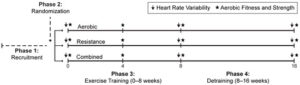
Unexpected events such as injury or lockdowns during pandemics may lead to a sudden decrease in physical activity participation, resulting in detraining. Even short-term detraining has been shown to reverse gains induced by exercise training, potentially resulting in negative health consequences. Heart rate variability is a non-invasive measure of cardiac autonomic modulation, is associated with general health outcomes, and has been reported as sensitive to exercise training and detraining. It remains uncertain how heart rate variability changes in response to exercise training and detraining among individuals in different age groups. In the current study, we examined heart rate variability in young and middle-aged men in response to exercise training that was immediately followed by an equal period of detraining. Prior to exercise training, we observed an age difference—higher values in young participants—in heart rate variability that was less evident after exercise training. But after the detraining period, age differences in heart rate variability were similar to baseline levels. These results suggest that heart rate variability differences between age groups may fluctuate in response to exercise training and detraining. Changes in heart rate variability may reflect changes in cardiovascular health, emphasizing the importance of future work in studying the relationships between heart rate variability, physical activity, aging, and cardiovascular health outcomes.
Abstract
We examined heart rate (HR) and heart rate variability (HRV) in young and middle-aged men after a period of detraining that immediately followed the completion of an exercise training program. Eight young (27.8 ± 3.8 years) and ten middle-aged (41.9 ± 3.8 years) men were randomly assigned to complete an 8-week exercise training program that included either aerobic (young: n = 3; middle-aged: n = 2), resistance (young: n = 3; middle-aged: n = 3), or combined (aerobic/resistance) (young: n = 2; middle-aged: n = 5) exercise. Thereafter, participants ceased all planned exercise training activities during an 8-week detraining period. Resting HR and HRV were assessed at baseline, after exercise training, and after detraining. An analysis of mean differences between age groups at each time-point revealed a significantly higher standard deviation of normal RR intervals (SDNN), square root of the mean of squared differences between successive RR intervals (RMSSD), high-frequency (HF) band (0.15–0.40 Hz), and cardiac vagal index (CVI) in young participants when compared to middle-aged participants at baseline (p ≤ 0.019) and after detraining (p ≤ 0.045), but not after the 8-week exercise training intervention (p ≥ 0.057). Additionally, in middle-aged participants, we observed a significant negative association between the percent change in HRV indices (RMSSD, HF, and CVI) and systolic blood pressure in response to detraining (p < 0.05). In conclusion, young participants had higher levels of HRV indices at baseline, reflecting greater cardiac vagal modulation when compared to middle-aged participants. We showed that these age-related differences in HRV are diminished following exercise training but are reestablished following 8 weeks of detraining. Given that age-related attenuations in HRV may reflect changes in cardiovascular health, it is important to further investigate the relationships between HRV, exercise training and detraining, aging, and the risk of poor health outcomes.
Keywords:
aging; autonomic nervous system; cardiac autonomic modulation; physical activity; resistance training; aerobic; COVID-19
Full Text Link: