
Brown HA, Topham TH, Clark B, Flouris AD, Ioannou LG, Telford RD, Smallcombe JW, Jay O, Périard JD. Evidence of seasonal heat acclimatisation in recreationally active adults during a mild summer. J Sci Med Sport. 2023 Oct 16:S1440-2440(23)00427-9. doi: 10.1016/j.jsams.2023.10.006. Epub ahead of print. PMID: 39492335.
Abstract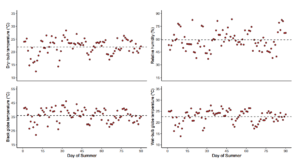
Objectives
To assess the magnitude of seasonal heat acclimatisation in recreationally active adults and contextualise the process by documenting the factors that influence adaptations.
Design
Longitudinal, repeated measures design.
Methods
Seventeen (7 females) recreationally active adults (28 ± 8 yr, V̇O2peak 54 ± 8 mL·kg−1·min−1) exercising outdoors a minimum of 5 h·wk−1 completed a 45-min heat response test running at 60 % V̇O2peak in 40 °C and 30 % relative humidity prior to, midway through, and following summer. Self-reported physical activity diaries were completed at the beginning and end of summer. Daytime wet-bulb globe temperature was calculated for each day of summer. Data were analysed using Bayesian ordinal regressions.
Results
Daytime wet-bulb globe temperature was 22.0 ± 4.4 °C, with the most common hour for recreational exercise being 17:00 to 18:00. Following summer, the rise in oesophageal temperature and mean skin temperature during the heat response test was lower by 0.12 °C [90 % credible interval: −0.30, 0.06; probability of direction = 87 %] and 0.43 °C [−0.74, −0.10; 98 %], respectively. Moreover, forearm local sweat rate increased by 0.26 mg·cm−2·min−1 [0.15, 0.36; 100 %]. There was minimal evidence of a change in the increase in heart rate (1 beat·min−1 [−3, 5; 62 %]), or whole-body sweat rate (0.03 L·h−1 [−0.11, 0.15; 68 %]) during the heat response test.
Conclusions
Although there was evidence of partial heat adaptation in recreationally active adults following summer, a combination of exercising later in the day and the prevailing environmental conditions (La Niña in South-Eastern Australia) may have blunted the development of further adaptations.
Keywords: Thermoregulation, Heat adaptation, Sweating, Core temperature
Full Text Link:
https://www.jsams.org/article/S1440-2440(23)00427-9/fulltext