
Ioannou LG, Tsoutsoubi L, Mantzios K, Gkikas G, Agaliotis G, Koutedakis Y, García-León D, Havenith G, Liang J, Arkolakis C, Glaser J, Kenny GP, Mekjavic IB, Nybo L, Flouris AD. The impact of workplace heat and cold on work time loss. J Occup Environ Med. 2025 Feb 7. doi: 10.1097/JOM.0000000000003332. Epub ahead of print. PMID: 39965897.
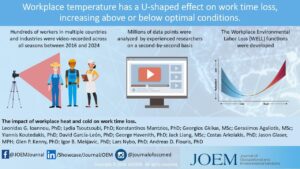
Abstract: Objective: We investigated the impact of workplace heat and cold on work time loss. Methods: Field experiments in different industrial sectors were conducted in multiple countries across all seasons between 2016 and 2024. Hundreds of workers were video-recorded and their full shifts (n = 603) were analyzed on a second-by-second basis (n = 16,065,501 sec). Environmental data were recorded using portable weather stations. The Workplace Environmental Labor Loss (WELL) functions were developed to describe work time loss due to workplace temperature. Results: The WELL functions revealed a U-shaped relationship whereby the least work time loss is observed at 18 °C (64 °F), and increases for every degree above or below this optimal temperature. Conclusions: The WELL functions quantify the impact of workplace temperature on work time loss, extending to temperatures previously believed to be unaffected.
Full Text Link: